
 on 24th February 2026
By Mariana Cevallos
The image of bees is a prominent element in Book IV of Georgics, a motif that has roots in the ancient Greek texts and tradition, where bees have a significant role in the construction of life, fertility, and industriousness.
We know from Hesiod that Zeus, as a little baby, was cared for, hidden, and nourished by nymphs in a cave, and from many sources we learn that he was fed with goat’s milk and honey. The term melissae is key, assuming multiple meanings, as the name of the producers of honey, the production itself, and the nymph that is directly connected with bees.
Virgil, in his Georgics, made a beautiful and exquisite description of the art of beekeeping, the care and ways of keeping bees safe, and the mythological and religious background connected with it. The plural form of the word, melissai, can refer both to the bees and the Kouretes, the attendants of Zeus, but it is also a way to refer to the nymphs in general, intimately connected to the divine and bucolic world. Virgil is not only speaking of the art of beekeeping, the bee as a fundamental creature for nature and rural life, but he is also, and in a wonderful way, speaking of ancient beliefs, gods, and even more, the feminine power and relevance linked to the symbolism of the bee.
The bee is a key representation and presence for the chthonic Gods–deities, always connected with Persephone, Demeter, and Aphrodite. In this sense, bees are part of notions such as fertility, resurrection, life cycle, and the power of femininity for the earth. Spinning even more finely, bees are also strategically connected to Dionysus, for it is said that Melissae was one of the nurses of this god when he was hidden from Hera. As a demi-god protector of bees, protector of Zeus and Dionysus, linked with Demeter and Persephone, the motif of bees transforms into an element of power that, when explored by Virgil, combines the golden-age longing, the current image of the political and social situation of Rome, with an ancient baggage loaded with deep meanings. Another interesting element connected with this motif is the prophetic tongue, the muses, and the bardic character. Bees were seen as animals that were always near the muses, guardians, attached to long life, a sweet voice, and words.
“For the poets tell us, I believe, that the songs they bring us are the sweets they cull from honey-dropping founts in certain gardens and glades of the Muses — like the bees, and winging the air as these do. And what they tell is true” Ion, Plato,534a
To all this, we can add an element of great value, and it is the connection between the motif of the bee and Aristaios, the person responsible for the death of Euridice. Virgil uses the story of Orpheus and Eurydice in his exploration of beekeeping, telling us about how Aristaios chasing her causes her death and therefore the later wrath of Orpheus. But this story gains even more strength if we think that Aristaios is the name of one of the kouretes nurses of Dionysus, and the fact that bees are a symbol of the guides of souls to the world of the dead. The journey of Euridice seen from this perspective gains a new light when Virgil conjugates it with the story of the bees, as well as the fact that the motif of life and death, underworld and rebirth is attached to all these elements, together with the fact of the poetic-bardic connection and the presence of bees with Orpheus and his divine gifts. The bees, the melissai as a powerful representation of ritual, nymphs, purity in the rite, give a higher meaning to book IV of the Georgics, making Virgil speak of the golden past, of longing for the rural and bucolic through the religious and poetic beauty of the Greek and divine knowledge.
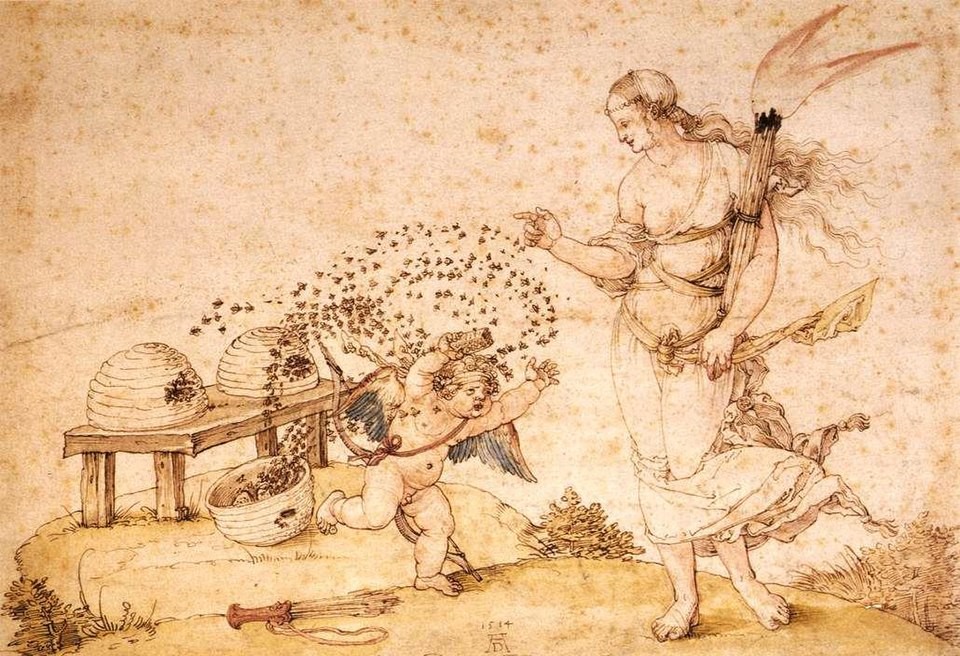
Image above: Dürer, Cupid the Honey Thief (1514), Kunsthistorisches Museum, Vienna
©️ Mariana Cevallos