
 on 11th March 2026
by Mariana Cevallos
There exists a profound connection in antiquity that relates the lament, the sorrow, and misfortune of death and loss with music, with song, the act of intoning and singing. It is part of the Greek heritage, the oral tradition and sensibility that is later found also in Roman literature, perhaps as an exploration of the duality of human emotions, the duality of fate itself.
The story of Orpheus and Eurydice is one of the most tragic, moving, and heartbreaking ones, a tale from ancient tradition that is, at its core, a love story, but primarily one of pain, catastrophe, and, with great relevance, music.
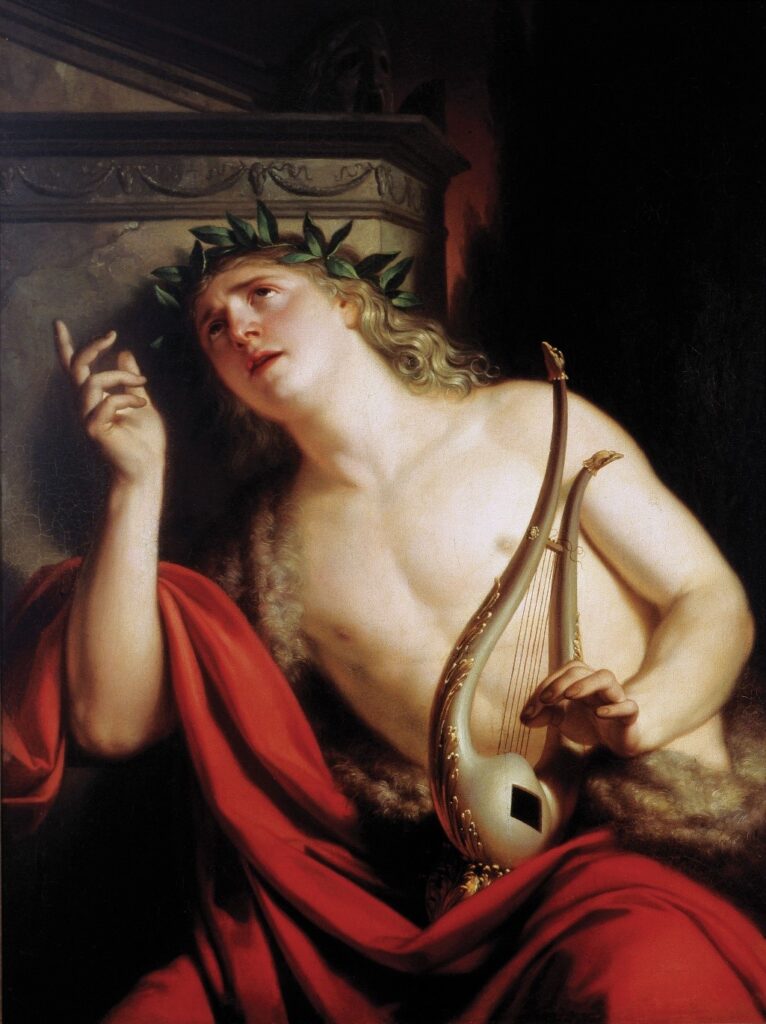
Their tragedy is told with special significance by Ovid and Virgil, although it was widely explored too by other authors like Seneca and Apollodorus. The deep pain that Orpheus experiences is well known, the helplessness in the face of the loss of his beloved wife, the katabasis, and the tragic end. But the story is much more complex than a love tale, for Orpheus, as the son of Apollo and master of music, represents in this narrative and own body the manifestation of song and lament as elements that converge, mix, and speak of ancient traditions.
Music is the common thread of the story, explicitly acting as the main reason thanks to which Orpheus is able to rescue Eurydice, and then as the conduit for his regret and final death.
Virgil, in his Georgics, book 4, lines 471-498, describes how music, the most beautiful and moving song from Orpheus, is marvelous enough to touch Proserpina and move her power and desire to allow the restitution of Orpheus’ wife from Hades, making possible the culmination of the katabasis and breaking the natural order only thanks to music. Here, song is the only element strong enough to defeat Hades, defeat fate and the underworld, and in doing this, the cosmic order.
In addition to this, Virgil describes an event of special and unique value for a mortal that dies, for in lines 454-503, it is nature as a whole what is going to sing a lament together with the Dryads in honor of Eurydice, being music an element that here collapsed with the funerary sing, with the deep lamentation for her pure soul.
“But her sister band of Dryads filled the mountaintops with their cries; the towers of Rhodope wept, and the Pangaean heights, and the martial land [Thrace] or Rhesus, the Getae and Hebrus and Orithyia, Acte’s child. But he, solacing an arching heart with music from his hollow shell, sang of you, dear wife, sang of you to himself on the lonely shore, of you as day drew nigh, of you as day departed”
It is essential to mention that as part of the katabasis, music and lament encapsulate another great episode, the shadows and psukes start a cry, they are moved because of the gift of Orpheus, something that can be read as a resemblance of death and music, death and life as necessary opposites.
“Stirred by his song, up from the lowest realms of Erebeus came the unsubstantial shades, the phantoms of those who lie in darkness, as many as the myriads of birds that shelter among the leaves when evening or a wintry shower drives them from the hills – women and men, and figures of great-souled heroes, their life now done, boys and girls unwed, and sons placed on the pyre before their fathers’ eyes. But round them are the black ooze and unsightly reeds of Cocytus, the unlovely mere enchaining them with its sluggish water, and Styx holding them fast within this ninefold circles. Still more: the very house of Death and deepest abysses of Hell were spellbound, and the Furies with livid snakes entwined in their hair; Cerberus stood agape and his triple jaws forgot to bark; the wind subsided, and Ixion’s wheel came to a stop.”
Music and lament constantly come together in this tale, Virgil grants a cyclical structure for is music and death, which creates a perfect shape and balance from the beginning. Everything starts with the lament for Eurydice, followed by the katabasis and the immediate new loss of the wife, to end again with a lament and the final death of Orpheus. In this sense, the structure begins with music and lament and ends in the same way, transforming both song and Orpheus into conductors of a cycle of life and death, darkness and light.
Finally, it is important also to mention the image of the swallow as bearer of lament and song with which Orpheus is usually compared, a motif that Virgil also presents and invites the reader to analyze this story and this specific element as an echo of past stories where swallow is usually portrayed as the perfect epitome of funerary cry, wedding songs and the best and most sorrowful sing. Orpheus and Eurydice here are part of this cycle of life and death and are reflected in each image taken up by Virgil from ancient Greek tradition.
Image: The Lament of Orpheus by Franc Kavčič